Weight of a New 3 Year Old Baby Girl
The Growing Kid: 3-Yr-Olds
How much will my child abound?
In 3-yr-olds, growth is still irksome compared to the first year. Nigh children accept get slimmer and lost the rounded tummy of a toddler. While all children may grow at a dissimilar charge per unit, the following indicate the average for 3-year-quondam boys and girls:
-
Weight: average gain of about 4 to half dozen pounds per year
-
Acme: average growth of about ii to 3 inches per year
-
Afterward age 2, children of the same age can noticeably vary in elevation and weight. Equally long as the child is maintaining his or her own charge per unit of growth, there should be no reason to worry. A discussion with the child's pediatrician is recommended if in that location is cause for concern.
What can my child do at this age?
Every bit your child continues to grow, you will discover new and heady abilities that develop. While children may progress at different rates, the following are some of the mutual milestones your child may reach in this age group:
-
Runs and jumps hands
-
Walks up stairs unassisted
-
Rides a tricycle
-
Washes and dries easily
-
Stacks x blocks
-
Easily draws straight lines and copies a circle
-
Can stand on tip-toes
-
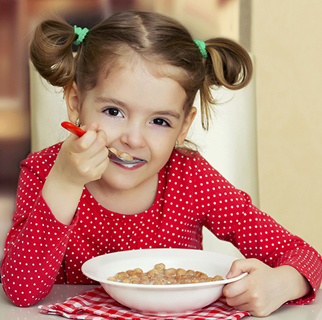
Uses spoon well and feeds cocky
-
Dresses and undresses self except for buttons and laces
-
Can concentrate on tasks for eight or 9 minutes
-
Has all 20 principal ("infant") teeth
-
Vision is nearing xx/20
-
Float and bowel control are usually established; uses potty chair or toilet
-
May sleep 11 to xiii hours total, may still accept a short afternoon nap
What can my child say?
Spoken communication development is very heady for parents as they watch their children begin to speak clearly and interact with others. While every child develops speech at his or her own charge per unit, the following are some of the common milestones in this age group:
-
Should be able to say about 500 to 900 words
-
Speech can be understood by others
-
Speaks in 2- or 3-word sentences and progresses to 4- or 5-word sentences
-
Can recollect simple rhymes or lyrics
-
Uses "please" and "thanks"
-
Refers to self by using own name
-
Names colors
What does my child understand?
While children may progress at unlike rates, the following are some of the mutual milestones your child may achieve in this age group:
-
Understands size differences (such as, large and little)
-
Understands past tense (yesterday)
-
Understands long sentences
-
Understands prepositions (on, under, behind)
-
Uses pronouns correctly (such as, I, you, he, and me)
-
Asks "why" constantly
-
Counts up to iv objects by iv years old
-
Says full name and age
-
May have fears of certain things (for example, night, monster under bed, and going down the bleed)
-
Attempts to solve bug
-
Remembers sure events
-
Can point to the right film when asked a simple question near it.
How does my kid interact with others?
While every kid is unique and will develop unlike personalities, the post-obit are some of the mutual behavioral traits that may be present in your child:
-
Begins to share and likes to play with other children
-
Tin can take turns
-
Atmosphere tantrums are less oft
-
Begins to show feelings in socially acceptable means
How to assist increase your child's learning and emotional security
Consider the post-obit as means to foster the emotional security of your iii-yr-old:
-
Spend time assuasive your kid to talk with you.
-
Teach your kid how things work.
-
Encourage play with other children.
-
Encourage your child to tell you stories.
-
Listen to your child and bear witness that you are pleased by your kid's talking.
-
Let your child exercise equally much equally possible for himself or herself when getting dressed, brushing teeth, and combing pilus.
-
Have your child aid with unproblematic chores such as picking upwardly toys.
-
Requite your child old apparel for "dress up" and allow him or her to pretend beingness a mom, dad, healthcare provider, cowboy, and the like. Even old sheets or towels can get skirts, capes, or turbans. You tin also pretend you lot are an elephant, butterfly, robot, or other characters and play with your child.
-
Sing songs or plant nursery rhymes and teach your child the words.
-
Read stories with your child and ask your child to proper name pictures in the stories or retell function of the story.
-
Help your child play with crayon and paper or chalk and chalkboard by showing how to draw circles and lines and then put them together to brand a stick effigy. Make figure faces that are happy, pitiful, or surprised, and talk about the different feeling shown in each moving-picture show.
-
Let your child build things out of blocks or boxes.
-
Give your child a safe space to ride a tricycle.
-
Listen to children's music with your child and dance.
-
Practise counting with your child.
-
Give your kid the chance to play games with other children. Church groups, YWCA or YMCA recreation centers, or libraries frequently take preschool programs.
-
Put puzzles together with your kid.
-
Let your kid have pretend playtime with dolls, cars, or toy cooking utensils.
-
Play hibernate and seek and follow the leader.
-
Let your child use his or her imagination by playing with play dough or dirt.
-
Trace your child'south hand or whole body and make a moving picture.
-
Show your child you are proud of whatever artwork and hang it up for display.
-
Teach your child colors.
-
Play ball with your child. Play different games with the ball, such as tossing a ball into a box or rolling the ball up and down an incline.
Source: https://www.hopkinsmedicine.org/health/wellness-and-prevention/the-growing-child-3yearolds
0 Response to "Weight of a New 3 Year Old Baby Girl"
Post a Comment