What Was the Thinly Sliced Pink Garnish on My Beef Rice Bowl

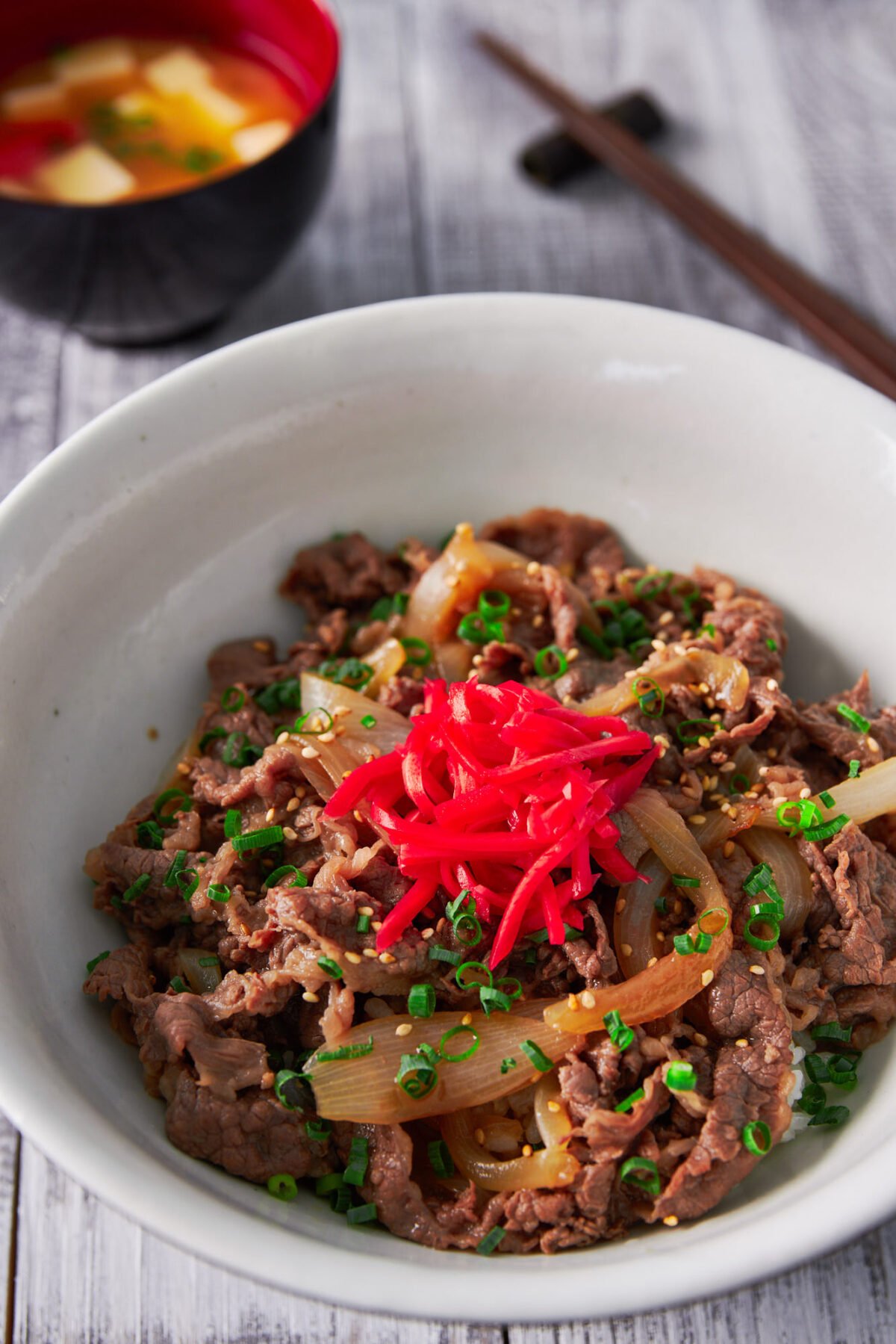
Gyudon (Japanese Beef Basin)
Gyudon (牛丼), which translates to "beef and rice bowl" is one of the most popular lunchtime meals in Japan. There are almost 5000 restaurants specializing this Japanese beef bowl scattered effectually Nihon which is almost double the number of McDonalds hither.
My Gyudon recipe is based on the manner popularized by Yoshinoya, with tender flavorful beef and sweet onions cooked in a savory sweet sauce, which percolates downwards into the rice underneath.
Table of contents
- Gyudon (Japanese Beef Bowl)
- Why This Recipe Works
- Gyudon Ingredients
- How to Make Gyudon
- FAQ
- Other Rice Bowls

Why This Recipe Works
- Using a fatty cutting of beef that's been sliced very thinly is the primal to making flavorful Gyudon.
- A sweet and savory dashi broth with a bit of white wine is the secret to making Gyudon that's similar to the original from Yoshinoya.
- Simmering the onions and beef in dashi keeps the meat moist and tender while creating a sauce that seasons the rice underneath.
Gyudon Ingredients
Beef
To brand an authentic Gyudon gustatory modality, you demand to utilize a cut of fatty beef. This not merely keeps the thin slices of beefiness moist, but the fat itself as well contributes a smoothen richness to the sauce. Yoshinoya is famously picky nigh their beef and only uses short-plate from American beefiness. They created a stir in 2004 when the BSE scare (and the ensuing ban on United states of america beef in Japan) caused them to supervene upon their iconic beef bowl with a pork bowl. For context, this would be akin to McDonald's halting sales of hamburgers in the U.s.a. and replacing them with chicken burgers.
As stocks of cheap US beefiness disappeared, Yoshinoya'due south competitors Matsuya and Sukiya responded by sourcing beef from other countries, but Yoshinoya stubbornly refused to compromise on quality and cost, sticking with pork until the ban was lifted over two years later on. While some consumers simply switched brands, some loyal Yoshinoya fan's went to the lengths of visiting the chain'due south foreign locations to bask their beloved Gyudon.
Brusk-plate can exist a flake hard to notice, which is why I like to utilize boneless short ribs for my Gyudon. It tends to have skillful marbling and is a picayune more than tender than short plate. If you alive in an area where Philly Cheesesteaks are popular, this is the another skilful option as the meat is sliced very thinly. Regardless of what cutting of beef you use, it's crucial to slice the meat thinly against the grain. This is what makes it possible to cook the meat for such a brusk amount of time and all the same nevertheless have it come out tender. If you're friendly with your local butcher, you lot tin effort asking them to cutting it for you on a meat slicer, or you can lightly freeze the beef and so use a very sharp pocketknife to piece it into sheets that are near 1/16 of an inch thick (~one.4mm).
Onions
I've tried a agglomeration of different types of onions hither including Welsh onions, and leeks, but I always finish upwards going back to patently one-time yellow onions. That's considering they tend to concord their shape the best. Juicer varieties such equally sweet onions, tend to turn to mush when you cook them for besides long, and red onions discolor, taking on an unappetizing grayness advent.
Gyudon sauce
Because Gyudon originated equally a hotpot, information technology's prepared in a similar manner; with the beef and onions cooked in a savory sweetness broth. I like making mine with a combination of dashi stock, white vino, sake, soy sauce, and sugar. The white wine contributes just a hint of acidity while adding a fruitiness that brings out the sweetness of the onions. The sake adds plenty of umami, and the soy sauce seasons the broth.
If you're a die-hard Yoshinoya fan and desire to get the same taste, you lot're going to demand to use Hondashi granules (which contains MSG) to make the dashi. Personally, I find this a little heavy-handed, resulting in an artificial taste. That'south why I adopt to utilize a batch of dashi prepared using my homemade dashi recipe.

Gyudon condiments
While purists, tend to prefer their Gyudon unadorned, I like adding toppings such as benishōga (crimson pickled ginger), scallions and sesame seeds, which contribute layers of texture and gustatory modality. Hither'due south a list of some of my favorite condiments for Gyudon:
- scallions – Brownish on white isn't a very flattering look, and a sprinkle of scallions helps add together a splash of color while fortifying the flavour of the onions in the Gyudon.
- benishōga – benishōga or "red ginger" is immature ginger pickled in the tangy juices produced while making umeboshi (pickled plums). Although these days the color is often added through dissimilar means, it was originally colored by the red shiso leaves added to umeboshi. The tangy, salty pickles add a nice colour and taste dissimilarity to the beefiness, and the ginger helps smooth out the rough edges of the beef.
- sesame seeds – toasted sesame seeds not only add a wonderful texture to the Gyudon, but they besides give the donburi a wonderful nutty flavor that pairs beautifully with the beef.
- onsen tamago – onsen tamago, or "hot spring egg", is essentially a sous vide egg. It's cooked in its beat at 145.five degrees F for near 45 minutes, which renders the egg white soft and custardy while thickening up the yolk and giving it a rich buttery texture. Gyudon is a bit of an outlier amongst donburi's in that information technology doesn't include whatsoever egg, and calculation an onsen tamago on top fixes this minor oversight. You can also use a poached egg.
- aonori – aonori literally means "light-green nori" and they come in flakes that can be sprinkled on tiptop of things. They're well-nigh famous for going on dishes similar oykonomiyaki and takoyaki, but they add a touch of color and loads of season.
How to Make Gyudon
The commencement thing you want to practice is make the sauce for the Gyudon by calculation the dashi, white vino, sake, soy sauce, and saccharide to a frying pan. Then you lot want to add the sliced onion and melt it for a few minutes until the pieces showtime to become translucent.
Then, the sliced beefiness goes into the goop. Turn down the heat gently simmer the meat for nearly ten minutes, or until the beef is tender.
Serve the beef and onions over hot rice with some sauce drizzled over everything. Garnish the Gyudon with your favorite condiments such as chopped green onions, toasted sesame seeds, or pickled blood-red ginger.
FAQ
What is Gyudon
Gyudon literally means "beef rice bowl," and it's a type of donburi made with thinly shaved beefiness and onions simmered in savory-sugariness dashi broth. Because the beef is sliced paper-thin, information technology releases its flavor into the goop and becomes tender quickly. The combination of beef and broth gets poured over a bowl of hot rice and topped with various condiments.
How to Pronounce Gyudon?
Gyudon is a ii-syllable proper noun pronounced as follows (read the italicized parts).
gyu like hum y'all
don similar donut
Who invented Gyudon?
These days Nippon is famous for Wagyu beef, simply using cattle for nutrient is a relatively new concept that just dates dorsum to the latter half of the 19th century. 1 of the first areas to welcome foreigners was Tokyo, which is why it's no big surprise that Gyudon got its starting time at that place.
As with virtually new ingredients that work their way into a culinary civilisation, beef was initially in a way that was familiar to Japanese people: equally a hotpot (鍋 – nabé). The new dish became known as Gyunabé (牛鍋), and information technology was the precursor to modern-day Sukiyaki, Shabu Shabu, and Gyudon. In the latter part of the 19th century, enterprising vendors started selling gyunabe on top of a bowl of rice as a kind of fast nutrient, and it was called Gyumeshi (牛めし – "beef rice").
One of those vendors was a guy named Eikichi Matsuda, who was from a town called Yoshino near Osaka. He opened a small stall at Nihonbashi Fish Market in 1899 selling a hearty repast called Gyunabé Bukkake (牛鍋ぶっかけ – "covered in gyunabe") to the workers at the market. After the Nihonbashi market was destroyed during the Slap-up Kanto Earthquake, Matsuda moved Yoshinoya to the new market located in Tsukiji in 1926. Gyudon remained a specialty of the Tokyo area until the mid 20th century, when Yoshinoya started expanding outside of Tokyo.
Other Rice Bowls
- Tanindon (beef and egg bowl)
- Chicken Katsudon (chicken katsu basin)
- Oyakodon (chicken and egg basin)
- Taco Rice (Okinawan taco meat basin)
Yield: ii people
Prep Time: 2 minutes
Melt Time: 13 minutes
Total Time: xv minutes
For beef bowl
- 1 loving cup
- 2 tablespoons
sweet white wine (such as Riesling or Gewürztraminer)
- 2 tablespoons
sake
- 2 i/ii tablespoons
soy sauce
- 2 teaspoons
evaporated pikestaff sugar
- 250 grams
beef (very thinly sliced)
- 100 grams
onion (~1/2 large onion, thickly sliced)
- 400 grams
For garnish
-
sesame seeds (optional)
- one
scallion (chopped, optional)
-
benishōga (pickled red ginger, optional)
-
Add together the dashi, white wine, sake, soy sauce, carbohydrate, and sliced onions to a pan and bring to a boil over medium-loftier heat.

-
Reject the heat to maintain a simmer and cook the onions until they're mostly translucent (about 3 minutes)

-
Add together the beef, and turn down the heat to maintain a gentle simmer. Cook, stirring regularly until the meat is tender (near 10 minutes). Adjust salt.

-
Serve the beef over bowls of hot rice, with some of the cooking liquid poured over the beef and rice. Garnish the Gyudon with sesame seeds, scallions, and benishōga.

Nutrition Facts
Gyudon (牛鍋)
Amount Per Serving
Calories 644 Calories from Fat 243
% Daily Value*
Fat 27g 42%
Saturated Fat 10g 50%
Cholesterol 88mg 29%
Sodium 1733mg 72%
Potassium 721mg 21%
Carbohydrates 59g 20%
Cobweb 4g 16%
Carbohydrate 6g 7%
Protein 31g 62%
Vitamin A 60IU 1%
Vitamin C 4.9mg half dozen%
Calcium 91mg 9%
Iron 4.4mg 24%
* Percent Daily Values are based on a 2000 calorie diet.
Source: https://norecipes.com/gyudon-beef-bowl-recipe/
0 Response to "What Was the Thinly Sliced Pink Garnish on My Beef Rice Bowl"
Post a Comment